


Product Overview
Entel HT649 is a GMDSS survival craft VHF radio for emergency use at sea, with IP68 submersibility and rugged MIL-STD construction.
Includes a sealed primary emergency battery; The "P2" package also adds a rechargeable Li-ion battery and drop-in charger for routine use on board.
Key Features
- GMDSS survival craft VHF radio designed specifically for emergency communications after abandoning a vessel
- IP68 submersible to 2 metres for 4 hours, with rugged MIL-STD 810C/D/E/F/G construction
- Dedicated one-shot emergency battery with a long shelf life, ready for use when normal vessel power may no longer be available
- Available as HT649/P1 with the emergency battery or HT649/P2 with an additional rechargeable battery and charger
What is the Entel HT649?
The Entel HT649 is a specialised GMDSS survival craft VHF marine radio. Although it looks and operates much like a normal handheld marine VHF radio, its main purpose is very different: it is designed to remain available for emergency communications if a vessel has to be abandoned and the crew takes to a lifeboat, liferaft or other survival craft.
GMDSS stands for Global Maritime Distress and Safety System. Put simply, GMDSS is the international system used to help ships communicate in an emergency. It brings together marine radio, satellite communications, emergency beacons and other safety equipment so a vessel in distress can raise the alarm and rescuers, nearby vessels and survivors can communicate effectively. In Australia, GMDSS forms part of the maritime safety framework administered by AMSA under the international SOLAS system.
The HT649 performs one particular part of that system. It is a portable two-way VHF radio intended for survival craft communications. If the crew has left the main vessel, it provides a simple way for survivors to speak directly with rescue vessels, other nearby ships and other survival craft using recognised marine VHF channels. IMO rules specifically provide for portable two-way VHF radios to be used for this purpose.
Why is a GMDSS survival craft radio different from an ordinary handheld marine radio?
A normal handheld marine VHF radio is primarily an everyday communications tool. A GMDSS survival craft radio such as the HT649 is designed around a much worse situation: the main vessel may be damaged, sinking or already abandoned, normal electrical power may have failed and the radio may have to work after exposure to water, shock and severe weather.
That is why the HT649 is supplied with a dedicated CLB750G primary lithium emergency battery. This is a sealed, non-rechargeable, single-use battery intended specifically for emergency use. It is supplied with a security seal and an expiry date so the vessel can keep the battery stored and ready rather than repeatedly charging and discharging it during normal operations. Entel specifies a four-year shelf life for the emergency battery.
In an emergency, the important point is that the radio does not depend on a rechargeable battery having happened to be left on charge the night before. A correctly maintained emergency battery is kept unused until it is actually required.
This is one of the biggest practical differences between the HT649 and a normal handheld marine VHF radio.
GMDSS explained in plain English
GMDSS is not one particular radio or one particular distress button. It is an international maritime safety system designed so that a vessel experiencing an emergency has several recognised ways of calling for help and receiving safety information.
Depending on the vessel, its operating area and the regulations that apply to it, GMDSS equipment can include fixed VHF, MF and HF radios, Digital Selective Calling, satellite communications, EPIRBs, search-and-rescue locating devices and portable survival craft radios.
The HT649 fits into the last category.
Think of it as the radio that can continue the conversation after people have left the ship.
An EPIRB is excellent for telling search-and-rescue authorities that you are in distress and helping them locate you. A survival craft VHF radio serves a different purpose: it allows the people in the liferaft or lifeboat to actually communicate by voice with approaching rescue vessels and other nearby stations.
That can become particularly important during the final stages of a rescue, when survivors and rescuers may need to exchange straightforward information such as where the survival craft is, how many people are aboard, whether anyone requires urgent assistance and how a rescue or transfer is going to take place.
Designed for the conditions it may actually face
An emergency radio is not much use if it stops working as soon as it gets soaked.
The HT649 is rated IP68 and tested for submersion to a depth of 2 metres for up to 4 hours. It is also built to meet MIL-STD 810C/D/E/F/G environmental testing requirements covering demanding conditions such as shock, vibration, moisture and general rough treatment. Entel specifically describes the HT series as commercial-grade radios designed for harsh maritime environments.
That rugged construction matters because a survival craft radio may be carried through rain, spray and seawater, dropped during an evacuation or handled by people wearing gloves in poor conditions.
The controls are deliberately straightforward, with a clear display, channel up and down controls, a dedicated Channel 16 function, scan, monitor and a conventional Push-To-Talk button. The HT649 also produces loud audio, making communications easier around engines, wind, waves and other background noise.
Why carry a dedicated emergency VHF radio?
On a normal day, the vessel's installed radio system will generally provide better range, a larger antenna and access to the vessel's main electrical supply.
An abandon-ship emergency changes all of that.
The fixed radio stays with the vessel.
The vessel's batteries may be unavailable.
The antenna system may be damaged.
The bridge may be inaccessible.
A normal rechargeable handheld may be flat, damaged or somewhere that cannot be reached.
A properly maintained survival craft radio gives the crew a separate, portable communications system with its own dedicated emergency power source.
For vessels required to carry GMDSS survival craft radios, the number and type required depends on the vessel, its size, flag, voyage and applicable maritime regulations. Under SOLAS, for example, certain cargo vessels are required to carry two portable two-way VHF units while larger cargo vessels and passenger ships require three. Australian requirements are administered through AMSA's marine-order framework.
For vessels that are not legally required to carry one, a dedicated emergency handheld VHF can still provide an additional layer of communications resilience, particularly for commercial vessels, offshore operations and vessels travelling beyond easy mobile-phone coverage.
Exact carriage requirements should always be checked against the vessel's flag state, survey requirements, classification requirements and operating area.
Australian and Asia-Pacific use
The HT649 carries the European Wheel Mark because it has been certified under the European Marine Equipment Directive. It also has certification under the UK's Merchant Shipping (Marine Equipment) Regulations.
Those markings are important because they demonstrate that the radio has been developed and assessed as a genuine GMDSS survival craft radio, rather than simply being a waterproof recreational marine handheld. Entel's current Declaration of Conformity references the IMO and IEC standards applicable to survival craft portable VHF equipment, including IEC 61097-12 and IMO Resolution MSC.515(105).
For an Australian customer, however, the Wheel Mark should not be confused with an Australian regulatory approval mark. The relevant equipment, carriage and operator requirements depend on Australian maritime and radiocommunications rules.
AMSA gives effect to the revised international GMDSS requirements through Marine Order 27, including the IMO performance standards for survival craft portable two-way VHF equipment.
Australian marine VHF users also need to comply with ACMA's radio operating and qualification requirements. ACMA states that operators of marine radios other than 27 MHz equipment must hold the appropriate qualification or operate under the applicable supervision arrangements.
Elsewhere in the Asia-Pacific region, local requirements vary according to the vessel's flag state and where it operates, so purchasers should check the requirements of the relevant maritime authority or classification society.
HT649 compared with the Entel HT644
Also see: Entel HT644
The Entel HT649 and HT644 are closely related members of Entel's commercial-grade HT marine radio range, and physically they are very similar radios. Both are rugged handheld VHF marine radios designed for demanding maritime environments.
The important difference is their intended purpose.
The HT644 is a general-purpose handheld marine VHF radio. It is intended for normal day-to-day marine communications.
The HT649 is the dedicated GMDSS survival craft version. It is designed and certified for the much more specialised role of providing portable VHF communications as part of a vessel's survival and emergency equipment.
If you simply need a tough handheld VHF for everyday marine communications, the HT644 is generally the appropriate model.
If the requirement is for a GMDSS survival craft portable VHF, the HT649 is the appropriate model.
Marine VHF versus Marine UHF
Marine VHF and UHF radios can both be used around vessels, but they usually perform different jobs.
Marine VHF is the internationally recognised radio service normally used for communications between vessels and between vessels and shore stations. This includes calling other ships, harbour and port communications, safety traffic and distress communications. The HT649 operates in the marine VHF band because it needs to communicate with other vessels and rescue services using marine VHF channels.
Marine UHF is more commonly used for short-range communications between crew members working around the same vessel. On a large ship, for example, UHF radios might be used between deck crew, engineering staff, loading crews or other work groups.
UHF can therefore be very useful as an on-board crew communications system, but it does not normally replace the vessel's marine VHF system for ship-to-ship and ship-to-shore communications.
Entel's own HT marine range reflects this distinction: the HT644 and HT649 are VHF marine models, while the HT782/HT783 variants are intended for marine UHF applications.
Two Package Options
The HT649 is available in two versions: HT649/P1 and HT649/P2.
The radio itself is the same. The difference is the batteries and charging equipment supplied.
HT649/P1 – Emergency Package
The P1 package is aimed at installations where the HT649 is principally being carried as dedicated emergency equipment.
It includes the sealed primary emergency battery but does not include a rechargeable everyday-use battery or charger.
HT649/P1 Includes
- Entel HT649 GMDSS VHF survival craft radio
- Entel CLB750G primary lithium emergency battery
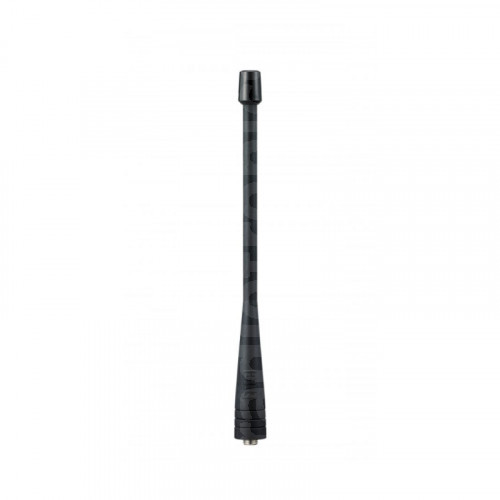
- Entel CAT40 VHF marine antenna
- Entel CBH750 spring-loaded belt clip
- Lanyard
- Quick Start User Guide
HT649/P2 – Emergency + Rechargeable Package
The P2 package contains everything in P1 but also includes a rechargeable battery and drop-in charger.
This is the more flexible option if the vessel wants to use the HT649 for training, familiarisation, testing or appropriate routine communications without using the sealed emergency battery.
The rechargeable battery can be used for normal operation while the primary CLB750G battery remains sealed and reserved for emergency use.
HT649/P2 Includes
- Entel HT649 GMDSS VHF survival craft radio
- Entel CLB750G primary lithium emergency battery
- Entel CNB750E rechargeable Li-ion battery
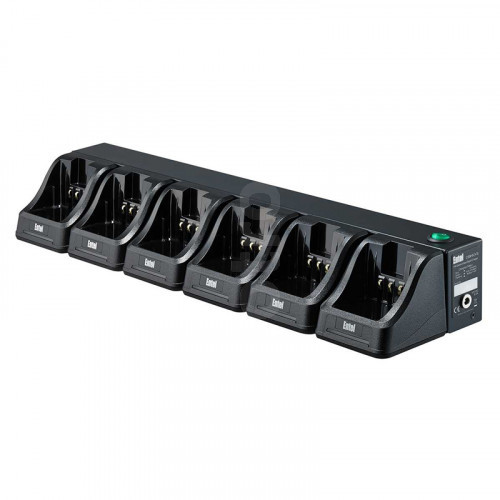
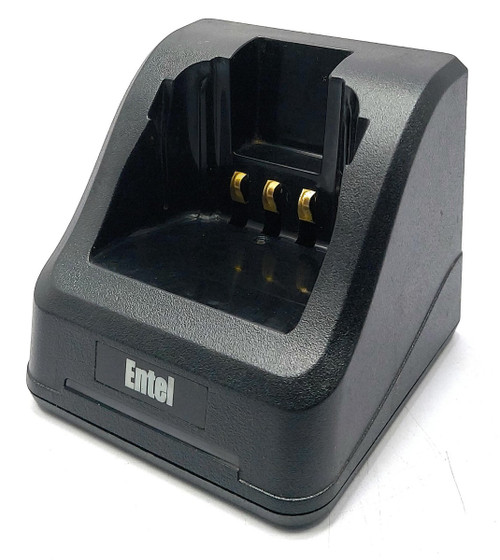
- Entel Drop-in Charger + Power Supply
- Entel CAT40 VHF marine antenna
- Entel CBH750 spring-loaded belt clip
- Lanyard
- Bulkhead screw spacer kit
- Quick Start User Guide
Entel's current HT649 user guide confirms that Package 2 consists of Package 1 plus the rechargeable Li-ion battery, drop-in charger and bulkhead screw spacer kit.
Primary Emergency Battery
The CLB750G primary battery is an important part of what makes the HT649 different from a normal rechargeable handheld radio.
It is a non-rechargeable lithium battery intended for emergency use only. The battery is supplied sealed, and Entel instructs that its security seal should only be removed when the battery is required for use.
An expiry date is printed on the battery and should be checked as part of the vessel's normal safety-equipment inspection routine. An expired emergency battery should be replaced rather than relied upon.
This arrangement provides a known emergency power source that has not been subjected to the repeated charging cycles and everyday use of a normal rechargeable radio battery.
Rechargeable Battery – P2
Package 2 also includes the CNB750E rechargeable Li-ion battery.
This gives operators a separate battery for routine use without disturbing the sealed emergency battery. The battery can be charged separately or while attached to the radio using the supplied drop-in charging cradle.
Entel states that a fully discharged CNB750E takes approximately six hours to recharge using the supplied charging arrangement.
IP68 Submersible Construction
The HT649 has an IP68 ingress-protection rating and is specified by Entel for complete submersion at a depth of 2 metres for up to 4 hours.
This is considerably more meaningful for a survival craft radio than simply describing a radio as splashproof or weather resistant.
The radio is designed to keep operating in conditions involving heavy rain, spray and accidental immersion. The accessory connector must remain correctly covered when no accessory is fitted to maintain the radio's submersible protection.
Rugged Commercial Marine Construction
The HT649 is designed to meet MIL-STD 810C/D/E/F/G environmental requirements.
These tests cover the types of stresses likely to be encountered by equipment used in demanding industrial and maritime environments, including shock, vibration, temperature, humidity and exposure to dust and moisture.
Combined with the IP68 enclosure, this makes the HT649 suitable for commercial maritime environments where equipment is expected to survive significantly rougher treatment than an ordinary consumer handheld radio.
Simple Emergency Operation
The HT649 deliberately remains straightforward to operate.
Controls include:
- Power on/off
- Push-To-Talk
- Channel up/down
- Dedicated Channel 16 selection
- Scan
- Monitor
- Keypad and display backlight
- Key lock
- Volume control
- LED transmit, receive and battery-status indication
A dedicated 16 button allows the operator to quickly switch between the current working channel and international marine VHF Channel 16.
Technical Specifications
The Entel HT649 is a portable VHF GMDSS survival craft radio operating across the international marine VHF band. It provides less than 1 watt ERP transmit power, loud 0.5-watt received audio and an IP68 enclosure tested to 2 metres for four hours. The radio operates from a 7.6V battery system, weighs approximately 277g with battery and antenna, and is designed for operation between -20°C and +55°C. Entel specifies MIL-STD 810C/D/E/F/G environmental construction.
General
- Product Type: GMDSS survival craft portable two-way VHF radiotelephone
- Frequency Band: Marine VHF
- Published Frequency Range: 156–163.275 MHz
- Channels: INT / USA / CAN marine channels
- Channel Spacing: 25 kHz
- Communication Method: Simplex / semi-duplex
- Antenna Impedance: 50 ohm
- Antenna Type: Whip / stubby
- Operating Voltage: 7.6V
- Primary Battery: CLB750G lithium primary emergency battery
- Secondary Battery: CNB750E rechargeable Li-ion battery with P2
- Nominal Current Drain: 40mA
- Secondary Battery Duty Cycle (5/5/90): Up to 17.5 hours
- Microphone: Internal condenser microphone
- Operating Temperature: -20°C to +55°C
- Construction: MIL-STD 810C/D/E/F/G
- Ingress Protection: IP68
- Submersibility: 2 metres for 4 hours
- Dimensions: 130mm H × 59.5mm W × 37mm D
- Weight: Approximately 277g with battery and antenna
Transmitter
- RF Output: Less than 1W ERP
- Frequency Stability: ±1.5ppm
- Modulation Limiting: ±5.0kHz
- FM Hum and Noise: Better than -40dB
- Unwanted Emissions: Less than 0.25µW up to 1GHz; less than 1µW from 1GHz to 2GHz
- Adjacent Channel Power: 70dBc
- Audio Response: 300Hz to 3kHz, -6dB/octave
- Audio Distortion: Less than 5%
- FM Modulation: 16K0F3E
Receiver
- Frequency Stability: ±0.5ppm
- Analogue Sensitivity: Better than 6dBµ for 20dB SINAD
- Intermodulation Response: Better than 68dB
- Adjacent Channel Selectivity: Better than 70dB
- Spurious Rejection: Better than 70dB
- Rated Audio Output: 0.5W
- Audio Distortion: Less than 5%
- Hum and Noise: Better than -40dB
- Audio Response: 300Hz to 3kHz, -6dB/octave
- Conducted Spurious Emissions: Less than 2nW up to 1GHz; less than 20nW from 1GHz to 2GHz
Environmental
- Operating Temperature: -20°C to +55°C
- Storage Temperature: -40°C to +85°C
- Water Ingress: IP68
- Submersion Rating: 2 metres for 4 hours
- Shock and Vibration: MIL-STD 810C/D/E/F/G
- Humidity Testing: MIL-STD 810C/D/E/F/G
- Thermal Shock: MIL-STD 810C/D/E/F/G
- Drop Testing: MIL-STD 810C/D/E/F/G
- Packing Testing: MIL-STD 810C/D/E/F/G